The 10 Most Iconic JDM Cars of All Time
JDM NINJA · 6/30/2026
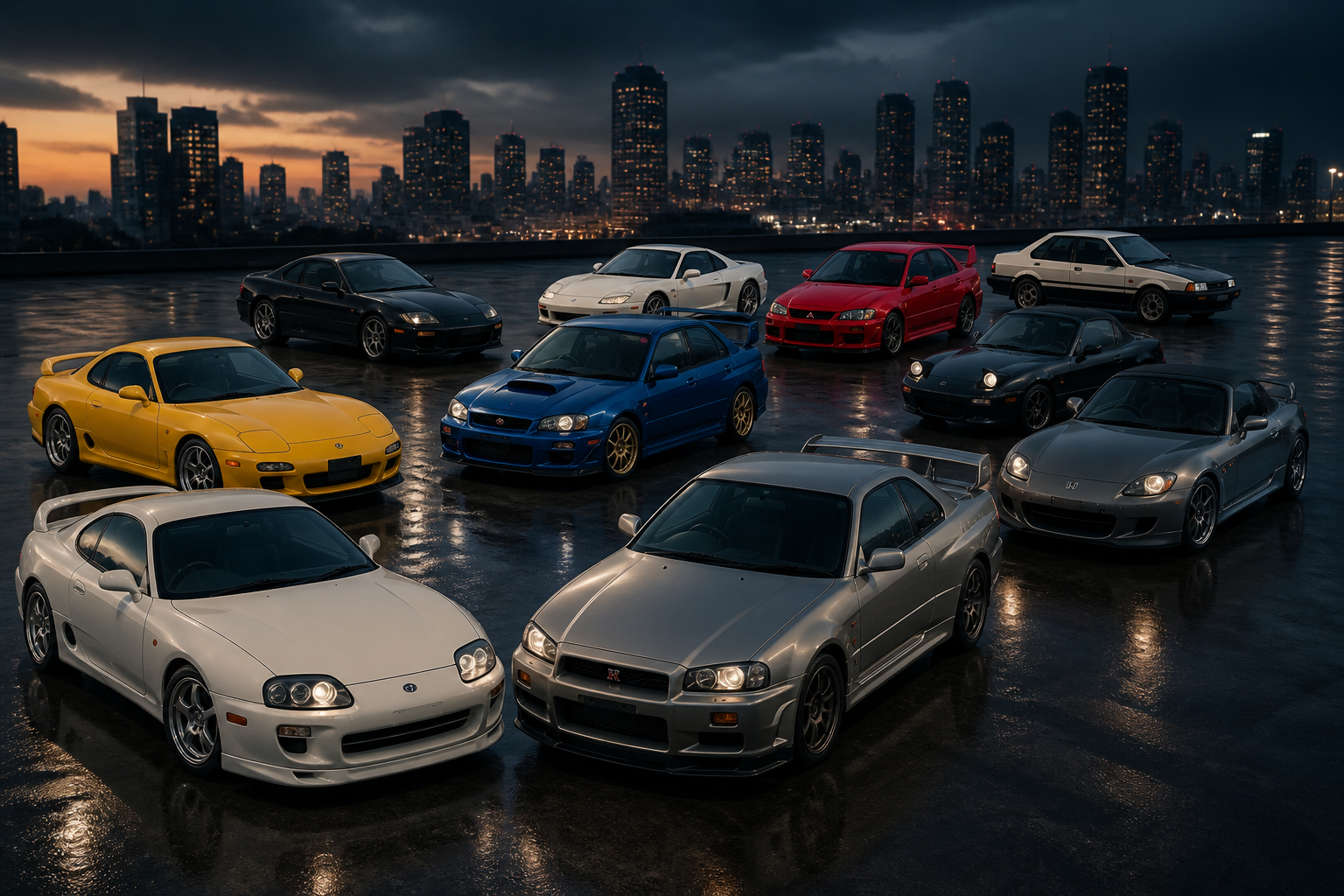
From twin-turbo AWD legends to lightweight naturally aspirated masterpieces, these are the ten JDM cars that defined a generation of performance driving and still command passionate followings worldwide.
What Makes a JDM Car Truly Iconic?
Iconic status in the JDM world doesn't come from sales numbers or marketing budgets. It comes from engineering ambition, driving character, and cultural impact. The cars on this list are the ones that changed what people believed was possible from a Japanese production car — and in most cases, changed what people believed was possible from any car at any price.
1. Nissan Skyline GT-R R34 (1999–2002)
The R34 GT-R is the most sought-after JDM car ever made. It combined the RB26DETT straight-six twin-turbo engine with ATTESA E-TS Pro all-wheel drive and a sophisticated multilink rear suspension. The NISMO 400R variant was factory rated at 400 horsepower in an era when supercars dominated that territory. Values have climbed relentlessly for over a decade, with clean examples now regularly selling above €150,000.
2. Toyota Supra A80 MK4 (1993–2002)
The A80 Supra built its reputation on the 2JZ-GTE engine — a 3.0-litre sequential twin-turbo straight-six that tuners famously push to 1,000 horsepower on the stock block. In standard form it produced 280 horsepower from the factory. The combination of engine strength, a bulletproof gearbox, and rear-wheel drive balance made it an immediate tuning icon. Prices have tripled in the last five years.
3. Mazda RX-7 FD3S (1992–2002)
The FD RX-7 is one of the most beautiful cars Japan ever made, and it was engineered to match its looks. The twin-rotor 13B-REW Wankel engine powered a car that weighed just 1,260 kg, resulting in handling so precise that professional drivers regularly name it among their all-time favourites. The rotary engine requires careful maintenance, but owners who respect it are rewarded with one of the most unique driving experiences in the world.
4. Honda NSX NA1/NA2 (1990–2005)
The original Honda NSX was designed with direct input from Ayrton Senna, who tested and critiqued development prototypes. It became the first all-aluminium production car body and the first supercar designed to be genuinely usable as daily transport. The naturally aspirated V6 was a benchmark for high-revving precision, and the chassis gave drivers a sense of connection that Ferrari and Porsche owners openly admired.
5. Mitsubishi Lancer Evolution VI Tommi Mäkinen Edition (1999)
The Lancer Evolution VI TME is named after the Finnish rally champion who delivered Mitsubishi four consecutive World Rally Championship titles. The road car received titanium-turbine turbocharger upgrades, suspension tuned to Mäkinen's specification, and a front lip spoiler that became the template for every Evolution after it. It represents the direct, unfiltered transfer of World Rally Championship technology to a road car.
6. Subaru Impreza WRX STI GC8 (1994–2000)
The first generation STI established the template that all subsequent Imprezas followed: flat-four turbo engine, symmetrical all-wheel drive, and handling tuned to extract maximum performance from rally-derived geometry. The gold Prodrive alloy wheels became one of the most recognisable visual signatures in performance car history. Early STIs are now appreciating rapidly.
7. Nissan Silvia S15 (1999–2002)
The S15 is widely considered the finest driving Silvia ever made. The SR20DET engine in its final form produced a reliable 250 horsepower, and the chassis refined every lesson learned from the S13 and S14 generations. Its combination of balance, communicativeness, and tunability made it the foundation of global drift culture. It was never officially sold in Europe or the United States, making every example on those roads a grey import.
8. Honda Integra Type R DC2 (1995–2001)
The DC2 Type R held the Front-Wheel-Drive lap record at the Nürburgring for years. It achieved this not through exotic technology but through obsessive lightness, a close-ratio gearbox, and Honda's B18C engine — which produced 200 horsepower from 1.8 litres without any forced induction, revving to 8,400 rpm. Red-painted cam covers, Recaro seats, and a helical limited-slip differential came as standard. It remains the benchmark naturally aspirated front-wheel-drive sports car.
9. Toyota AE86 Corolla Levin/Trueno (1983–1987)
The AE86 is the oldest car on this list and arguably the most culturally significant. The lightweight rear-wheel-drive coupe powered by the 4A-GE engine became the car that defined Initial D, the manga and anime series that introduced an entire generation to JDM performance culture. Even today, well-preserved examples command serious money, and AE86 restoration and tuning communities are as active as they were thirty years ago.
10. Mazda MX-5 NA (1989–1997)
The original MX-5 Roadster belongs on any list of iconic Japanese cars because it single-handedly revived a class of sports car that was disappearing. Mazda deliberately designed it around driving pleasure: rear-wheel drive, a 50/50 weight balance, limited electronic assistance, and a naturally aspirated engine that encouraged revving. Thirty-five years after its launch, the original formula remains the blueprint for lightweight roadster design worldwide.
About the author
JDM NINJA
JDM NINJA is written and edited by Lucas Tougaard, a Denmark-based importer and owner of Japanese-market performance cars since 2019. Every guide is researched in-house from auction results, factory documentation and hands-on ownership — read how we source and verify our data in our editorial standards, or send a correction.
Published 6/30/2026 · Updated 9/7/2026