The Engineering Reality Behind JDM's Legendary Swap Engines: 2JZ, RB26, and SR20
JDM NINJA · 7/15/2026
The 2JZ, RB26 and SR20 are treated as interchangeable legends. They were designed for completely different jobs — here is what each one is actually good at, what it costs to own, and how to choose between them.
Every JDM conversation eventually arrives at the same three engines. The 2JZ-GTE, the RB26DETT and the SR20DET are treated as interchangeable legends, but they were designed for completely different jobs, and the reasons they became swap favourites have very little to do with what made them good in the cars they came in.
The 2JZ-GTE: over-engineered by accident
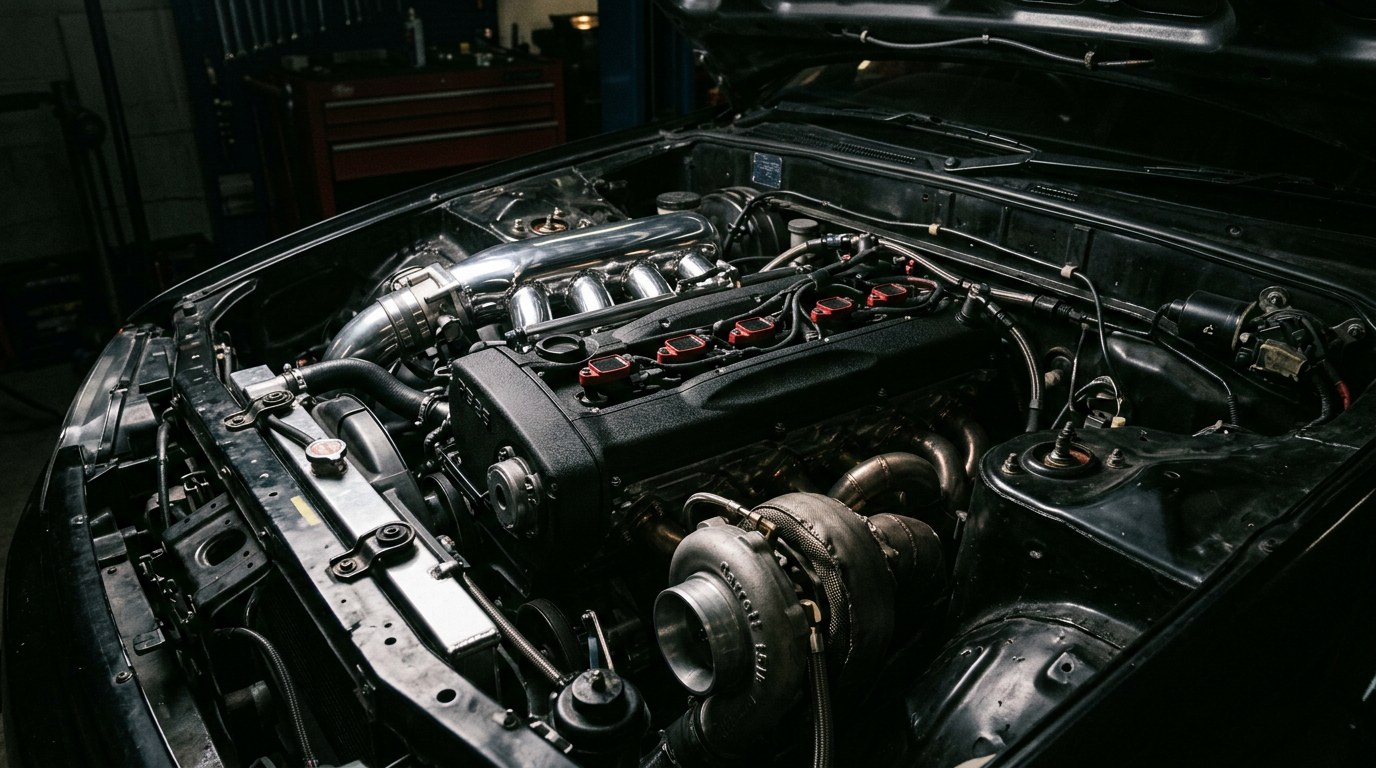
Toyota designed the 2JZ-GTE for a luxury grand tourer. That single fact explains everything people love about it. A closed-deck cast-iron block, seven main bearings, and a bore-to-stroke ratio chosen for smoothness rather than peak power produced a bottom end with margin that no marketing department ever asked for.
The factory output was 276 hp in Japan and 320 hp in export Supras. What matters is what happens above that. The standard rods and pistons handle roughly 600–700 hp reliably with fuelling and cooling sorted, and the block itself will take four figures with forged internals. No other production straight-six of the era comes close on cost per horsepower.
The trade-offs are real. It is a heavy engine — around 200 kg dressed — and it sits high and long, which is why swaps into small chassis change the car's balance significantly. The sequential twin-turbo system is complex, and most builds bin it for a single turbo within a year.
See it in its natural habitat on our Supra MK4 page, or in the cars almost nobody thinks of: the Aristo V300 and the naturally aspirated IS300.
The RB26DETT: built to win a championship
The RB26DETT exists because Nissan needed to win Group A. It was designed around a 2.6-litre displacement specifically to fall into the right class once the turbo equivalency factor was applied, and it carried six individual throttle bodies, individual ignition coils and an oiling system developed for sustained racing loads.
That focus produces a very different engine from the 2JZ. Response is sharper, the induction noise above 5000 rpm is unlike anything else, and the airflow potential of the head is excellent. But the oil pump drive collar is a known weak point at high rpm, the ceramic turbine wheels on standard turbos fail under raised boost, and the block's oil return design causes problems in sustained high-power use.
| Engine | Layout | Stock output | Realistic stock-internals limit | Rebuild complexity |
|---|---|---|---|---|
| 2JZ-GTE | 3.0L iron I6, twin turbo | 276–320 hp | ~650 hp | Low |
| RB26DETT | 2.6L iron I6, twin turbo | 276 hp | ~500 hp | High |
| SR20DET | 2.0L iron I4, single turbo | 202–247 hp | ~350 hp | Low |
The RB26 is also the most expensive of the three to own, because demand from R34 GT-R and R32 GT-R owners sets the price of every part.
The SR20DET: the one that taught a generation
The SR20DET was never a hero engine. It was a mainstream Nissan four-cylinder fitted to Silvias, Pulsars and vans, and it became legendary because it was everywhere, cheap, compact and light enough to swap into anything.
Around 250 hp is easy, 350 hp is achievable on standard internals with the right turbo, and the aftermarket has solved every problem it has. Its weaknesses are equally well documented: the standard oil pickup starves under sustained lateral load, head gasket failure follows boost increases without ARP studs, and the S13 red-top and S14 black-top variants have meaningful differences in compression and cam timing.
For drifting specifically, the SR's low weight is why it still wins arguments against the 2JZ. Less mass over the front axle means faster direction changes, and 350 hp in a 1200 kg S13 is more than enough to learn on.
So which one is actually the best?
The honest answer depends on what you are building.
- Big power on a budget: the 2JZ-GTE, without argument. Nothing else offers this much bottom-end strength for the money.
- Authenticity and response: the RB26DETT, if you accept that maintaining one properly costs more than the engine itself in most cases.
- Balance, weight and learning: the SR20DET. It is the engine that makes a chassis better rather than heavier.
The mistake most first-time builders make is choosing the engine before choosing the goal. If your car is going to spend its life on mountain roads and the occasional track day, a well-maintained SR20DET will be more satisfying than a 700 hp 2JZ that needs a rebuild every season.
Planning an import to build one? Run the numbers on landed cost first with our import calculator, then compare candidate chassis in our car database.
About the author
JDM NINJA
JDM NINJA is written and edited by Lucas Tougaard, a Denmark-based importer and owner of Japanese-market performance cars since 2019. Every guide is researched in-house from auction results, factory documentation and hands-on ownership — read how we source and verify our data in our editorial standards, or send a correction.
Published 7/15/2026 · Updated 9/7/2026