
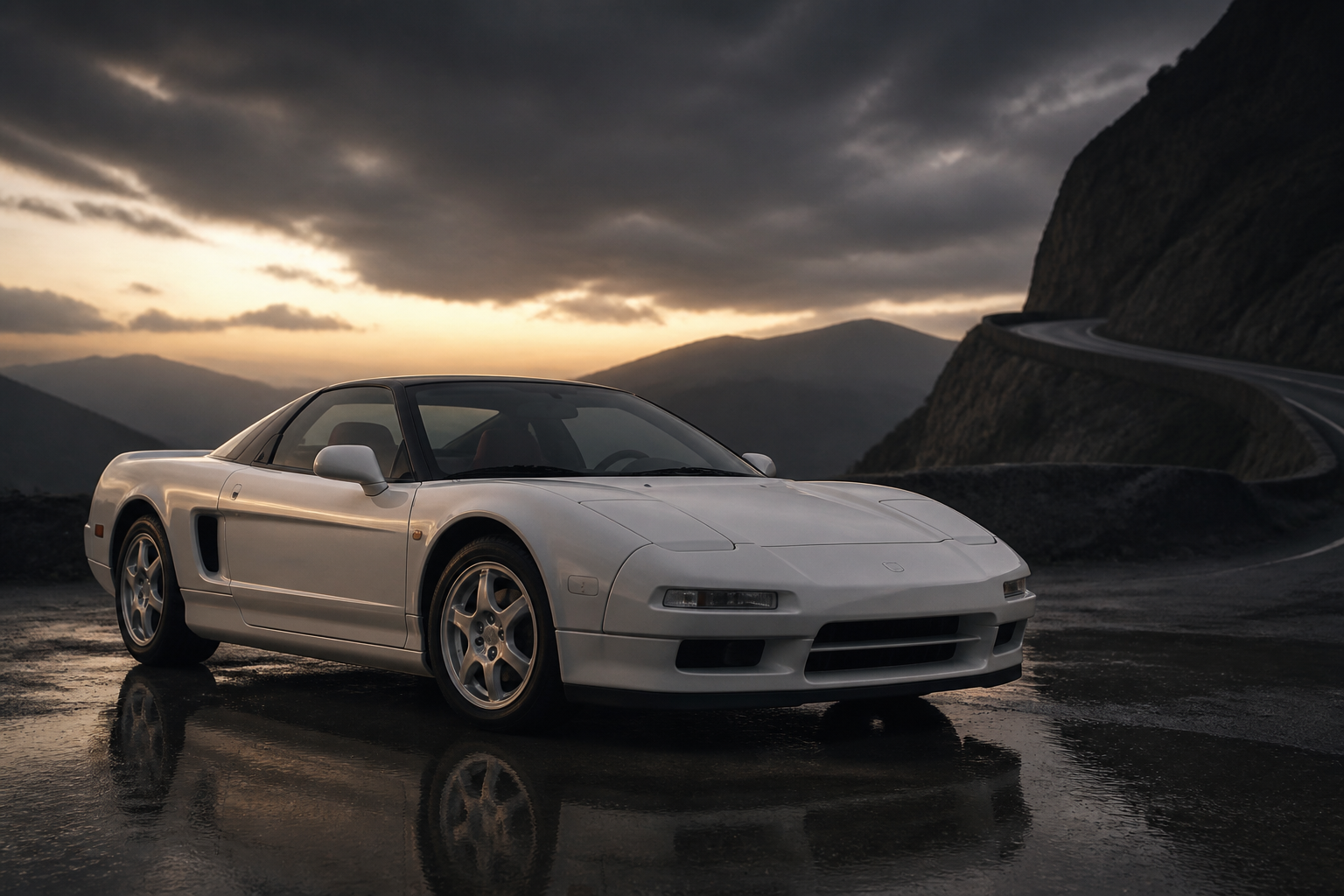
Honda NSX: Japan's Greatest Sports Car, Explained
JDM NINJA · 6/30/2026
The original Honda NSX was Japan's first genuine supercar — designed with Ayrton Senna's input and engineered to prove that a Japanese manufacturer could beat Ferrari at its own game. Here's the full story.
The Car That Humbled Ferrari
In 1989, Enzo Ferrari died and Honda launched a prototype that would change the sports car landscape. The project was codenamed NS-X — New Sportscar Experimental — and its brief was specific: build a car that could challenge Ferrari on performance, exceed Ferrari on everyday usability, and never penalise its driver for choosing to drive it daily. Honda succeeded on every count.
When contemporary automotive journalists tested early NSXs against a Ferrari 348, the Honda matched or exceeded the Italian car's lap times while being easier to drive, more reliable, and considerably cheaper. The Ferrari's handling was described as nervous and demanding. The Honda's was described as perfectly balanced and transparent. It was a seismic result.
Ayrton Senna's Contribution
During the NSX's development program, Honda's engineers faced a problem: their test drivers were reporting that the car felt too light, too disconnected at the limit. The feedback was technically accurate but lacked the precise language needed to fix it. Honda invited Ayrton Senna — at that point the reigning Formula One World Champion and a Honda engine customer — to drive development prototypes at Suzuka.
Senna's feedback was immediately actionable. He described exactly what the car was doing at the limit, why it felt uncertain, and what changes to spring rates and front suspension geometry would address the problem. Honda's engineers implemented his recommendations. The production NSX's celebrated handling feel is, in measurable part, the result of Senna's technical input. This is not marketing mythology — Honda engineers from the project confirmed it on record.
Engineering Firsts
The NSX was the first production car in the world to use an all-aluminium body structure. At the time, aluminium body panels were used by a few exotic manufacturers, but no one had built an entire stressed aluminium monocoque for a production car. The result was a body that weighed 40% less than an equivalent steel structure while being significantly stiffer. This achievement required Honda to develop entirely new aluminium joining and stamping technologies.
The C30A engine — a 3.0-litre naturally aspirated V6 mounted longitudinally behind the driver — used titanium connecting rods, making it one of the first production cars to use titanium in its engine internals. The VTEC variable valve timing system allowed the engine to deliver docile low-rpm behaviour and aggressive high-rpm power without compromise. Maximum output was 274 horsepower in NA1 specification, which doesn't sound dramatic today but was exceptional for a naturally aspirated 3.0-litre in 1990.
NA1 vs NA2: The Key Differences
NA1 (1990–1997) — The original. 3.0-litre C30A engine, pop-up headlights, 270–274 horsepower depending on market. Manual gearbox with a rare and exotic titanium shift mechanism. Fixed-roof coupe only in first production years, then a Targa roof option followed. The purist's choice.
NA2 (1997–2005) — Refreshed version with a 3.2-litre C32B engine producing 290 horsepower, a new six-speed gearbox, revised suspension, and a wider front track. Fixed headlights replaced the pop-ups. Many drivers consider the NA2 the better overall car for its improved power delivery; collectors increasingly favour the NA1 for its originality.
What to Check When Buying
NSX engines are very strong when properly maintained, but they do not tolerate neglect. The C30A and C32B both require regular timing belt changes — Honda specifies 90,000 km or 7 years, but most specialists recommend 60,000 km on a car this old. Ask for documentation of belt changes as a priority. The VTEC system requires clean oil to function correctly; check for any signs of oil degradation or the wrong specification oil having been used.
The aluminium body does not rust, but it can corrode in specific areas — particularly around the suspension mounting points and where dissimilar metals meet. Check these areas carefully. Any previous accident repair to the aluminium structure should be inspected by a specialist before purchase.
What Does an NSX Cost in 2026?
Clean, original NA1 examples in Europe now trade between €60,000 and €120,000 depending on specification, history, and mileage. Low-mileage Targa models with documented service history command the highest prices. NA2 examples with the 3.2-litre engine trade between €50,000 and €90,000. Values have been rising steadily for over a decade and the NSX is now firmly established as a blue-chip classic.
About the author
JDM NINJA
JDM NINJA is written and edited by Lucas Tougaard, a Denmark-based importer and owner of Japanese-market performance cars since 2019. Every guide is researched in-house from auction results, factory documentation and hands-on ownership — read how we source and verify our data in our editorial standards, or send a correction.
Published 6/30/2026 · Updated 9/7/2026