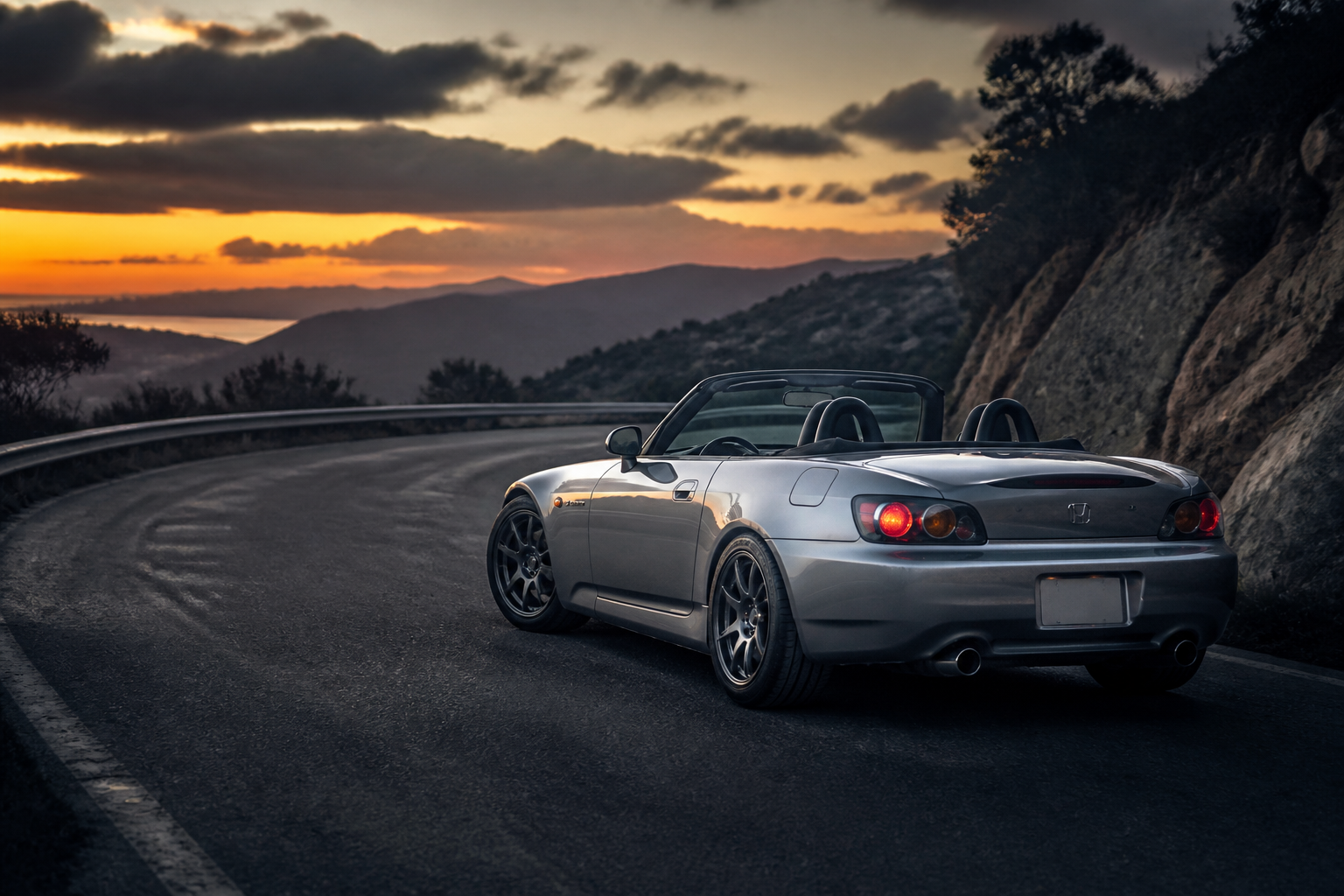
Honda S2000: The Last Great Naturally Aspirated Roadster
JDM NINJA · 6/30/2026
A 9,000 rpm redline from a 2.0-litre engine with no turbo in sight. Here's why the S2000 remains one of the most engaging sports cars Japan ever built.
Why the S2000 Still Feels Special
The Honda S2000 is one of the clearest examples of a car built around an engine and gearbox. The AP1's F20C revs to 9,000 rpm, the six-speed manual is famously precise, and the compact rear-drive chassis rewards drivers who are smooth and committed. It is not the easiest roadster, but that is why it remains so memorable.
Unlike many modern performance cars, the S2000 does not hide its limits behind huge torque or heavy electronics. It asks the driver to work: choose the right gear, keep the engine in its powerband and respect the rear axle. For the right buyer, that involvement is the whole point.
AP1 vs AP2
The AP1, sold from 1999 in many markets, uses the 2.0-litre F20C and has the most extreme rev-happy character. The later AP2, depending on market, brought suspension changes and in some regions the larger F22C engine with more torque and a lower redline. Enthusiasts often prefer the AP1 for purity and the AP2 for road usability.
If you are shopping internationally, confirm the exact market specification. Engine, gearing, suspension tuning and emissions equipment can vary. Do not rely on registration year alone.
Common Problems and Checks
The F20C is strong, but it is not a neglected-engine survivor in the way some lower-stress Hondas are. Oil level is critical because the engine revs so high. Ask for service history, listen for timing-chain tensioner noise and check whether valve clearances have been adjusted. Misfires, rough idle or heavy oil use need investigation.
Early cars can be sensitive at the rear, especially on old tyres or poor alignment. Inspect suspension bushings, dampers, differential mounts and accident repairs. Roof wear, water leaks, worn seat bolsters and tired synchros are also common. A car that has been tracked is not automatically bad, but it should have brake, tyre and fluid history to match.
What It Costs to Own
The S2000 is more expensive than an MX-5 but usually simpler than turbocharged JDM icons. Genuine parts can be costly, and clean body panels or interior trim are becoming more valuable as cars age. Tyres matter hugely because the chassis is sensitive to grip balance. Cheap mismatched tyres can make a good car feel nervous.
Fuel economy is reasonable when cruising but drops when driven as intended. Insurance can be high because values have risen and many cars have accident histories.
Who Should Buy One?
Buy an S2000 if you want a focused driver's car, not a relaxed convertible. It is best for someone who enjoys revs, precision and mechanical feel. If you want effortless torque, daily comfort or cheap parts above all else, a 350Z, MX-5 or GT86 may suit better.
The right S2000 is straight, documented and not over-modified. Pay for a car that feels tight and honest. The F20C is special enough that saving money on a questionable example rarely ends well.
About the author
JDM NINJA
JDM NINJA is written and edited by Lucas Tougaard, a Denmark-based importer and owner of Japanese-market performance cars since 2019. Every guide is researched in-house from auction results, factory documentation and hands-on ownership — read how we source and verify our data in our editorial standards, or send a correction.
Published 6/30/2026 · Updated 9/7/2026