
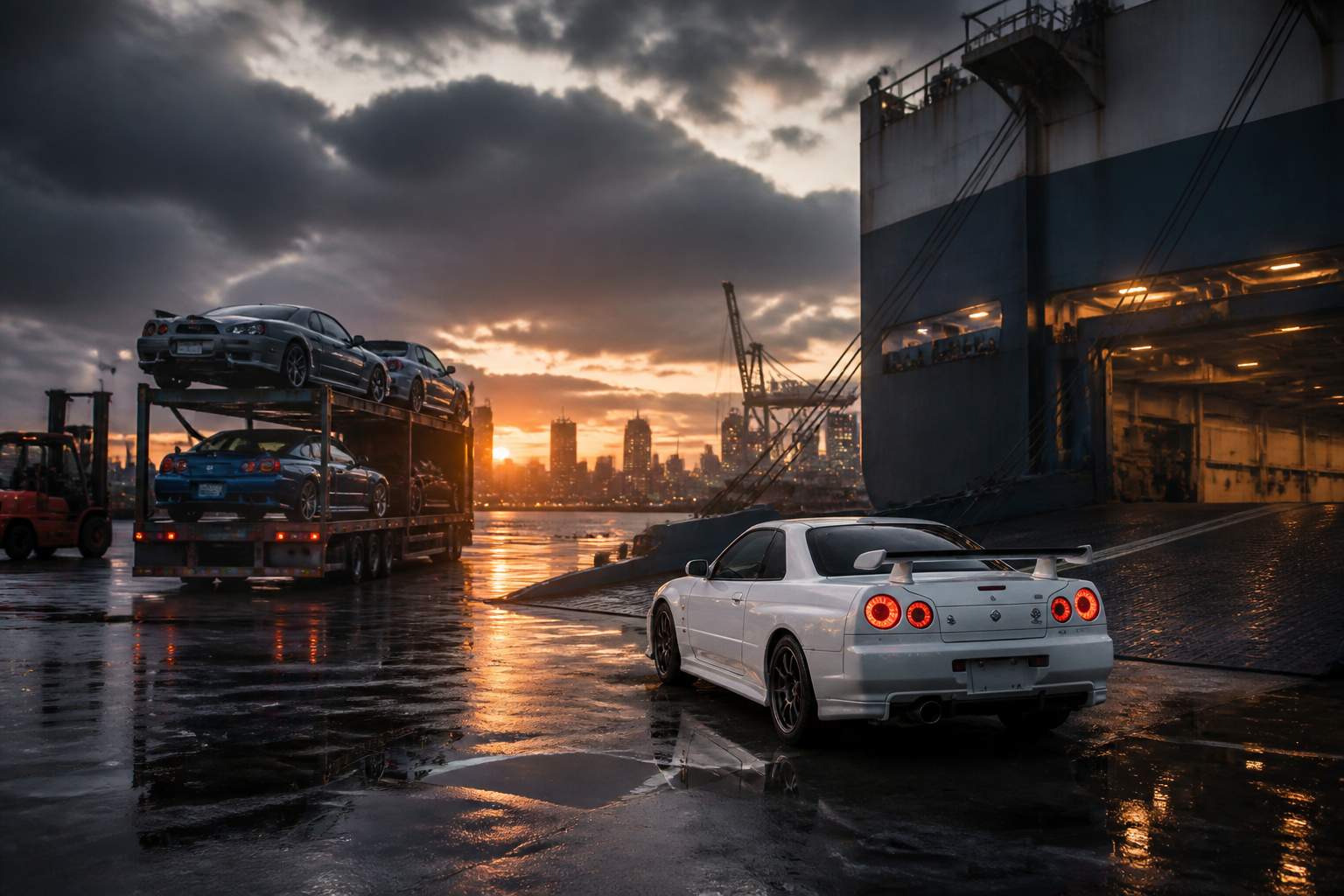
How to Import a JDM Car From Japan to Europe: The Complete Guide
JDM NINJA · 6/30/2026
Importing a JDM car from Japan sounds complicated, but thousands of enthusiasts do it every year. Here's exactly how the process works, what it costs, and what pitfalls to avoid.
Why Import Directly From Japan?
Japan is the cleanest, most reliable source of used cars in the world. The combination of strict annual inspections (called shaken), low average mileage, excellent maintenance culture, and a climate that's gentler on bodywork than most of Europe means that Japanese auction cars are consistently better preserved than equivalent domestic examples.
Importing directly also gives you access to specifications, colours, and options that were never officially sold in Europe. If you want the full JDM experience — the right interior, the right engine tune, the right production date — importing from Japan is often the only option.
Step 1: Find Your Car at a Japanese Auction
The majority of used car imports from Japan go through the Japanese auction system. The four largest auction houses — USS, TAA, JU, and Aucnet — process hundreds of thousands of vehicles every week. Each car is independently inspected and graded on a scale from 1 (poor) to 5 (excellent), with sub-grades for interior and exterior condition.
You don't bid directly. Instead, you work with a registered importer or buying agent who has auction access. They bid on your behalf, handle payment, and arrange export. Some well-known European agents include JM Imports, Cars and Classics Japan, and various country-specific specialists. Always verify that your agent is registered and has verifiable customer reviews before sending any money.
Step 2: Verify the Car's History
Once you have a candidate, run a full history check. In Japan, this means requesting the vehicle's inspection history from the Land Transport Bureau. Your agent or importer can usually do this for a small fee. Check that the chassis number matches the auction sheet, that the car hasn't been in a major accident (auction grade D indicates damage), and that all modifications listed on the documentation are accurate.
For performance cars, ask specifically about engine modifications, turbo condition, and whether the car has been used on a circuit. Track use isn't necessarily a dealbreaker, but it affects how you assess the drivetrain.
Step 3: Arrange Shipping to Europe
Cars are shipped from Japan in one of two ways: RoRo (Roll-on Roll-off, where the car is driven onto a ship and secured in an open vehicle deck) or container shipping (where the car is loaded into a sealed steel container). RoRo is cheaper, typically €400–€700 from Japan to a Northern European port. Container shipping costs €1,000–€1,500 but offers more protection and is preferred for pristine or valuable cars.
Transit time is typically 5–7 weeks from Japan to Rotterdam, Bremerhaven, or other major European ports. Your importer coordinates this, and you'll receive a Bill of Lading when the car ships — keep this document carefully, as you need it for customs clearance.
Step 4: Customs, Duties, and VAT
When the car arrives in Europe, it must clear customs. For most European countries, this involves paying a 6.5% import duty on the car's declared value, plus the local rate of VAT (25% in Denmark, for example). These costs are calculated on the purchase price plus shipping costs combined. Budget carefully for this step, as it can significantly affect the total cost.
Your importer or a customs broker handles the paperwork. You'll need the Bill of Lading, the Japanese export certificate, the original invoice, and a completed customs declaration. In Denmark, cars must also comply with Danish vehicle registration requirements, which may require specific lighting modifications or other adjustments.
Step 5: Registration and Roadworthiness
After customs clearance, the car must pass a technical inspection (syn in Denmark) and be registered with the relevant authority. Some modifications may be required — typically lighting adjustments for European roads. Once it passes inspection and registration is complete, the car receives local plates and is fully legal to drive.
Registration tax in Denmark can be very significant for performance cars, so factor this into your budget calculation from the very beginning. Use the JDM NINJA import calculator to estimate the full landed cost before you commit to buying.
Total Cost Summary
As a rough guide for a car purchased at auction for €15,000: expect to add approximately €600–€1,200 for shipping, €1,000–€1,500 for import duty and VAT processing, and then local registration tax on top. The full landed and registered cost is often 40–70% above the Japanese auction price. This is not a reason to avoid importing — the quality and specification advantages usually make it worthwhile — but accurate budgeting from the start avoids nasty surprises.
About the author
JDM NINJA
JDM NINJA is written and edited by Lucas Tougaard, a Denmark-based importer and owner of Japanese-market performance cars since 2019. Every guide is researched in-house from auction results, factory documentation and hands-on ownership — read how we source and verify our data in our editorial standards, or send a correction.
Published 6/30/2026 · Updated 9/7/2026