Mazda RX-7 FD3S: Is It Still Worth Buying in 2026?
JDM NINJA · 6/30/2026
The FD RX-7 is one of the most beautiful and most technically demanding Japanese sports cars ever made. Here's an honest guide to what living with a rotary engine really involves — and whether the reward is worth the commitment.
One of Japan's Most Beautiful Machines
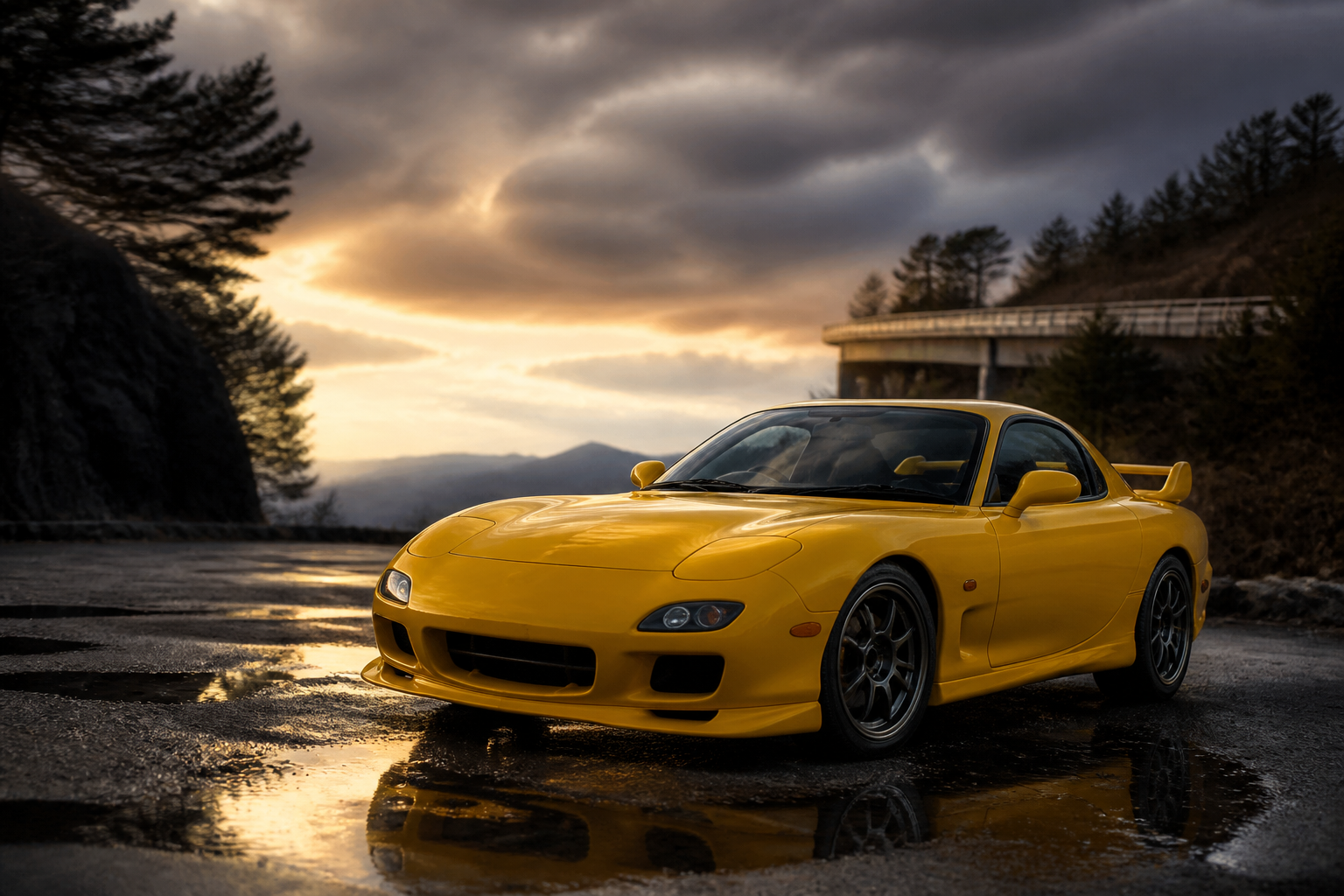
The third-generation RX-7, known internally as the FD3S, was produced from 1992 to 2002 and is widely regarded as the visual peak of Japanese sports car design. Mazda's chief designer Yoichi Sato created a silhouette that has aged better than virtually any of its contemporaries — low, smooth, wide at the rear haunches, and with a front end that still looks purposeful and original thirty years later.
The beauty was not purely cosmetic. The FD was engineered as a lightweight performance machine: a 13B-REW twin-rotor Wankel engine mounted well behind the front axle, near-perfect front-rear weight balance, a double wishbone suspension setup at all four corners, and a total kerb weight of just 1,260 kg. On the right road, the FD3S delivers handling precision that very few cars — at any price — can match.
Understanding the Rotary Engine
The 13B-REW is not a conventional piston engine, and approaching it with conventional expectations will lead to frustration. The Wankel rotary uses triangular rotors that spin eccentrically within oval housings, creating combustion without reciprocating pistons. This produces a unique combination of characteristics: it is smooth, high-revving, and very compact, but it requires different maintenance thinking than any piston engine.
Rotary engines consume oil as part of their normal operation. The engine meters small amounts of oil into the combustion chamber to lubricate the apex seals — the critical sealing elements that sweep around the rotor housing. This is not a fault. It is the design. Budget for oil top-ups between services and never run the engine on low oil.
The apex seals themselves are the most common wear item. On a high-mileage or poorly maintained engine, they can fail — the first signs are a flooded condition on cold start (hard starting, multiple cranks required) and a loss of compression on one or both rotors. A compression test with a rotary-specific gauge is essential before purchase.
Common Problems
Flooding: The most frequent RX-7 complaint. If the car has been started, moved a short distance, and shut off repeatedly — or if the previous owner made many short journeys — unburned fuel accumulates in the engine. Always run an RX-7 to full operating temperature before shutting it off.
Cooling system: The 13B-REW runs hot under load. The original cooling system is adequate for normal driving but requires full service attention. All coolant hoses, the thermostat, and the radiator cap should be renewed on any high-mileage example. Overheating is one of the most damaging things that can happen to a rotary engine.
Sequential turbo system: The FD uses a primary and secondary turbocharger in sequence. The changeover mechanism is complex and involves solenoid valves, actuators, and vacuum lines that age over time. A hesitation between approximately 4,500 and 5,000 rpm indicates the secondary turbo isn't coming in correctly and the system needs attention.
Rust: Check the rear chassis rail area behind the rear wheels, the door bottoms, and the floor behind the seats.
Running an RX-7: The Reality
The FD3S requires a specialist. Finding a mechanic who is comfortable with rotary engines is step one — standard motor factors may not stock seals or rebuild kits. Budget a higher maintenance allowance than for a comparable piston-engine sports car, and plan for a full engine rebuild at some point in ownership if you buy a high-mileage example. A professional rebuild to original specification costs approximately €3,000–€6,000 depending on the specification.
For owners who accept and prepare for these requirements, the RX-7 is one of the most rewarding cars in the world. The engine note, the balance, the steering feel, and the mechanical purity of the experience are unlike anything else. The commitment it demands is also part of what makes owning one feel special.
What Does an FD3S Cost in 2026?
Clean FD3S examples in Europe now trade between €25,000 and €60,000 depending on specification, history, and condition. The Spirit R — the final limited-edition variant produced in 2002 — commands a significant premium, with the best examples exceeding €80,000. Values have risen substantially over the past decade and show no sign of declining for well-maintained examples.
About the author
JDM NINJA
JDM NINJA is written and edited by Lucas Tougaard, a Denmark-based importer and owner of Japanese-market performance cars since 2019. Every guide is researched in-house from auction results, factory documentation and hands-on ownership — read how we source and verify our data in our editorial standards, or send a correction.
Published 6/30/2026 · Updated 9/7/2026