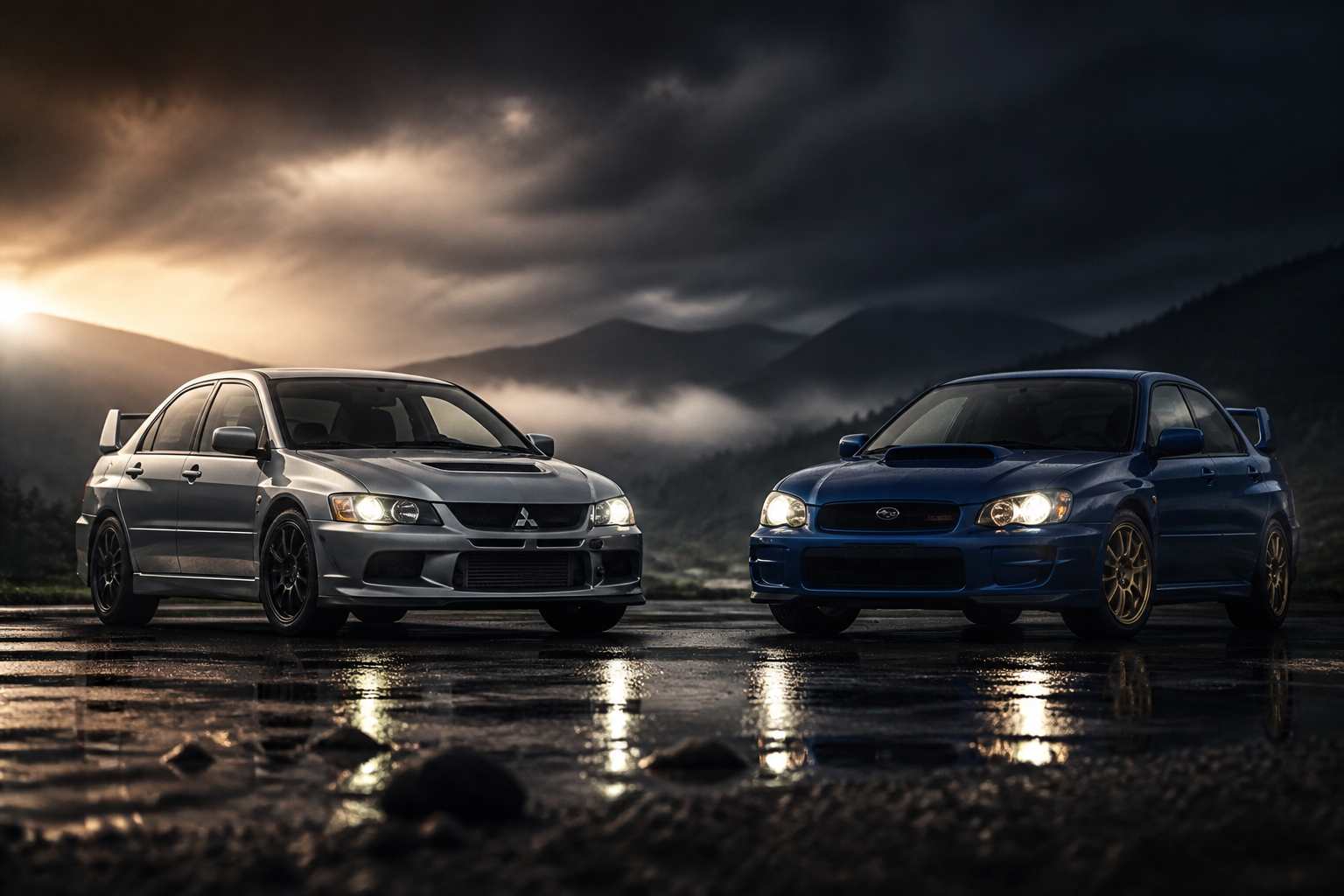
Mitsubishi Lancer Evolution vs Subaru Impreza WRX STI: The Complete Rivalry
JDM NINJA · 6/30/2026
The Mitsubishi Lancer Evolution and Subaru Impreza WRX STI defined the golden era of all-wheel-drive turbocharged rally road cars. Here's the complete story of the greatest rivalry in JDM history.
The Rally Road War
Through the 1990s and into the 2000s, Mitsubishi and Subaru fought one of the most intense rivalries in motorsport history across the World Rally Championship stages of Finland, Australia, Britain, and Corsica. Simultaneously, they fought the same battle on public roads — each releasing new Evolution and new Impreza generations in rapid succession, each one attempting to out-develop the other in power, handling, and all-weather performance. For buyers, this competition produced the most accessible and capable all-wheel-drive performance cars that have ever been built.
The Mitsubishi Lancer Evolution: Built From the Rally Stage
The Lancer Evolution began in 1992 as a homologation special — Mitsubishi needed to produce 2,500 road cars to qualify their competition car for the World Rally Championship. The first Evolutions were raw and direct, offering 250 horsepower from the 4G63 turbocharged engine and a sophisticated all-wheel drive system developed in direct conjunction with the competition programme.
By the time the Evolution VI Tommi Mäkinen Edition arrived in 1999 — named after the four-times champion who had brought Mitsubishi its World Rally titles — the car had become a finely tuned instrument. Active Yaw Control, which could alter torque split between the rear wheels independently, gave the Evolution a degree of handling adjustability that no comparable road car offered. Drivers who learned to exploit it could place the car with extraordinary precision on any surface.
The Evolution IX (2005–2007) is widely considered the engineering peak. The MIVEC variable valve timing system was applied to the 4G63 for the first time, improving throttle response and reducing turbo lag. The handling balance between the active front differential, centre differential, and AYC rear differential reached its most sophisticated expression. The IX produces 280 horsepower in standard form and remains one of the most technically accomplished performance cars of its price class.
The Subaru Impreza WRX STI: Rally Bred, Road Legal
Subaru's approach was different in philosophy. Where Mitsubishi built the Lancer on a relatively narrow interpretation of homologation requirements, Subaru used the WRX and STI programme to demonstrate that performance and everyday usability were compatible. The Impreza's symmetrical all-wheel-drive system — a layout where the drivetrain runs exactly along the car's centreline — was not just a performance choice. It was a philosophical statement about how a car should be built.
The first generation WRX STI (GC8, 1994–2000) used the EJ20 turbocharged flat-four with outputs ranging from 250 to 280 horsepower depending on the specification year. The chassis, tuned with input from the WRC team, offered a level of tractability and confidence in poor conditions that the Mitsubishi's sharper setup couldn't match for inexperienced drivers. The STI was the easier car to go fast in.
The GDB STI (2001–2007) brought the engine to 2.5 litres on most variants, added the Driver Controlled Centre Differential for adjustable torque split, and refined the handling with a multi-link rear suspension. The Prodrive Performance Pack, available in some markets, brought further suspension and braking improvements to a car that was already very capable.
Evo vs STI: How Do They Really Differ to Drive?
The Mitsubishi is the sharper, more demanding car. Its steering is more direct, its chassis is tuned to a higher pitch, and the Active Yaw Control system rewards drivers who push it with intuitive corner exit control that feels almost telepathic. On a dry circuit or a smooth mountain road, the Evolution is the more exciting and more rewarding car. It demands commitment and understanding, and it pays both back in full.
The Subaru is the more accessible, more versatile car. The symmetrical AWD system inspires confidence in conditions where the Evolution feels more on edge. The flat-four engine has more low-end torque and a more relaxed power delivery. Driven across winter roads, poor-weather motorways, and mixed terrain, the Impreza is the more natural companion. Many STI owners report that their car has never once left them stranded by bad weather. That's a hard thing for a rival to compete with.
Which Generations to Buy Today
For the Evolution, the VI Tommi Mäkinen Edition and the IX are the benchmark variants. The VII and VIII brought a new body but lost some of the purity of the older chassis; the X that followed in 2007 was larger, heavier, and has never inspired the same passion.
For the STI, the GC8 first generation is the collector's choice — raw, direct, and tied directly to the championship-winning years. The GDB generation offers the best balance of performance, usability, and modern features. Avoid examples with unknown service history on the EJ20 or EJ25 engines due to head gasket concerns.
The Legacy
Both Mitsubishi and Subaru eventually stepped back from this class of car. The last Lancer Evolution X ended production in 2016. The Subaru WRX STI that replaced the GD generation drifted toward grand tourer territory, and Subaru's WRC withdrawal removed the direct competition pressure that had sharpened every generation before it. What remains is a catalogue of road cars that were better for having had each other to compete against — the most directly traceable case in automotive history of motorsport competition making ordinary people's road cars dramatically better.
About the author
JDM NINJA
JDM NINJA is written and edited by Lucas Tougaard, a Denmark-based importer and owner of Japanese-market performance cars since 2019. Every guide is researched in-house from auction results, factory documentation and hands-on ownership — read how we source and verify our data in our editorial standards, or send a correction.
Published 6/30/2026 · Updated 9/7/2026