RB26DETT vs 2JZ-GTE: The Greatest Engine Debate in JDM History
JDM NINJA · 6/30/2026
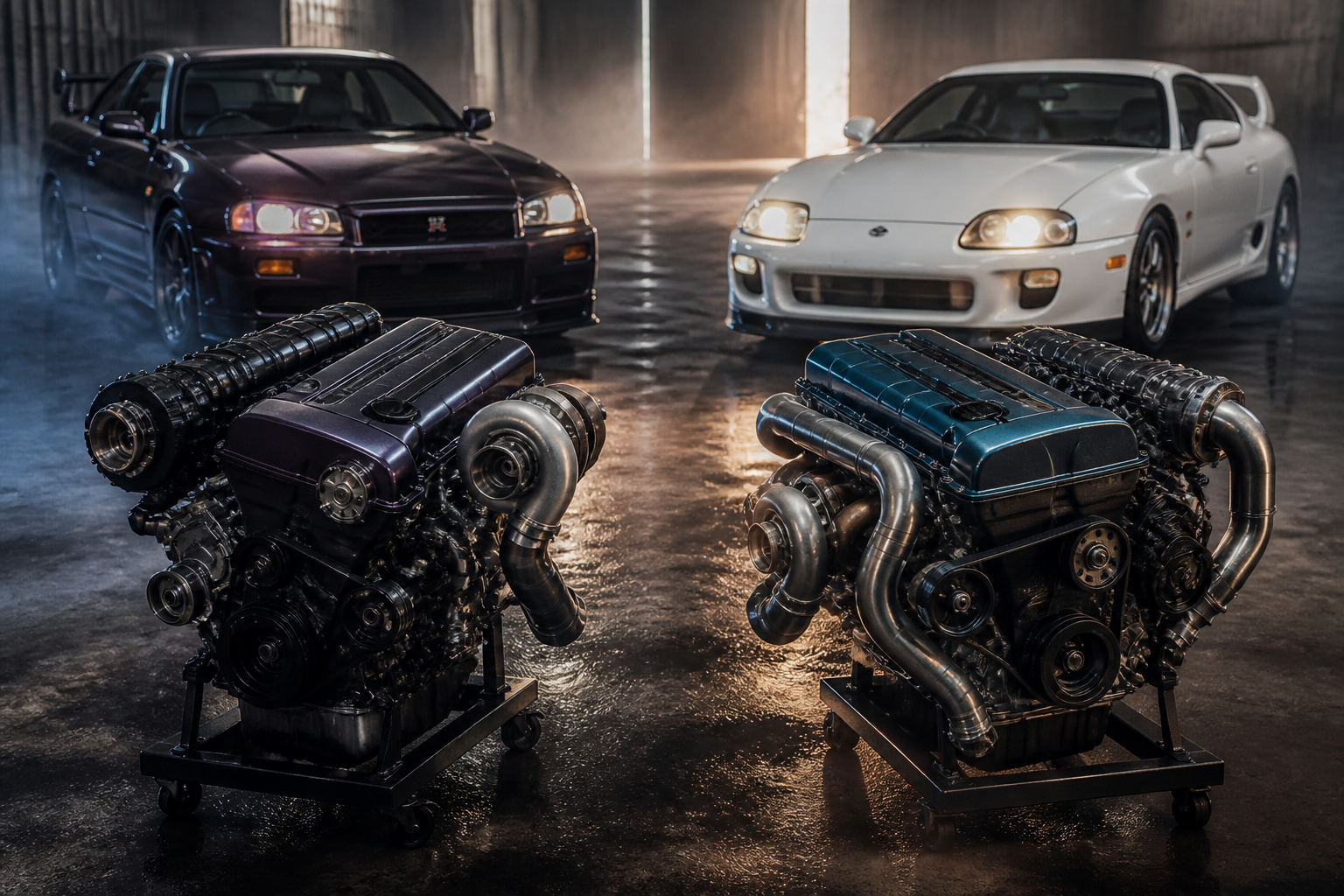
The RB26DETT from the Nissan GT-R and the 2JZ-GTE from the Toyota Supra are the two most celebrated JDM performance engines ever made. Here's an honest, detailed comparison of both.
The Two Legends
In the 1990s, Nissan and Toyota each produced a straight-six twin-turbocharged performance engine that would define their brand's sporting reputation for decades. The RB26DETT went into the Skyline GT-R family. The 2JZ-GTE went into the Supra MK4. Both engines have been tuned beyond 1,000 horsepower. Both have powered record-setting race cars. Both remain in active use by performance builders today, thirty years after their introduction. The debate over which is greater has never fully been settled.
The RB26DETT: Precision Engineering for the Racetrack
Nissan developed the RB26DETT specifically around a single purpose: winning the Japanese touring car championship. The "26" in the name refers to a displacement of 2,568cc — the engine was deliberately displaced slightly under 2.6 litres to qualify for a specific race class. The twin Garrett T25 turbochargers were mounted as close to the exhaust ports as possible to minimise lag, and the combustion chambers were individually ported and matched to a higher standard than most production engines of the era.
The result is an engine that feels alive in a way that is difficult to describe to someone who hasn't driven one. It is linear, precise, and rewards high-rpm use with a mechanical intensity that is entirely its own. The sound — a characteristic inline-six howl layered over turbo whoosh — is one of the most celebrated engine sounds in automotive history.
On the downside, the RB26 is a more delicate engine than the 2JZ. It does not tolerate neglect well. Oil changes must be frequent, the cooling system requires attention, and pushing power beyond approximately 500 horsepower often requires internal strengthening. The original Getrag gearbox attached to it can also struggle above standard power levels.
The 2JZ-GTE: The Indestructible Tuning Platform
Toyota took a different approach with the 2JZ-GTE. Where the RB26 was a race engine adapted for road use, the 2JZ was a production engine designed for long life and reliability that happened to respond extraordinarily well to modification. The 3.0-litre displacement gave it more raw torque than the smaller RB26. The cast-iron block is massively over-engineered — the walls are thick, the main bearing cap supports are strong, and the bottom end can handle enormous power increases without internal modification.
This is why the 2JZ became the dominant engine in professional drag racing, time attack, and drift competition. A stock 2JZ bottom end running 800 horsepower on external modifications is not unusual. The same treatment on an RB26 would require significantly more internal work. For pure tuning potential measured in output per investment, the 2JZ wins clearly.
In character, the 2JZ is smoother and more relaxed than the RB26. It makes power from lower in the rev range and the power delivery feels more linear and predictable. It doesn't have the same razor-edged intensity at high revs as the RB26 — but it also doesn't need it, because it makes its power so effortlessly.
Head-to-Head Comparison
Standard power: Both are factory rated at 280 horsepower. Real output is approximately 320–330 horsepower on both engines in stock form.
Displacement: 2JZ-GTE wins at 3.0 litres vs 2.6 litres. This gives the 2JZ more torque at lower revs.
Tuning ceiling: 2JZ wins clearly. 1,000+ horsepower on the stock block is reliably achieved with the 2JZ. The RB26 typically requires bottom-end work above 600–700 horsepower.
Driving character: RB26 wins for high-rev excitement and mechanical intensity. The 2JZ is smoother and more linear.
Sound: This is genuinely subjective. The RB26 sounds like a race engine. The 2JZ sounds like authority.
Reliability: 2JZ wins when maintained properly. The RB26 is less forgiving of deferred maintenance.
Replacement parts availability: Both are very well supported globally. The 2JZ benefits from slightly better parts availability due to its use in multiple Toyota models beyond the Supra.
The Verdict
Choosing between these engines is ultimately a question of what you value. If you want the most capable tuning platform, the engine that gives you the most power per pound invested, and the smoothest power delivery: the 2JZ. If you want the most characterful, exciting, precision-feeling engine — the one that feels like it was hand-built for racing because it literally was — the RB26. Neither answer is wrong. Both engines represent the absolute peak of what Japanese engineering produced in the era before electronics began doing the driver's job for them.
About the author
JDM NINJA
JDM NINJA is written and edited by Lucas Tougaard, a Denmark-based importer and owner of Japanese-market performance cars since 2019. Every guide is researched in-house from auction results, factory documentation and hands-on ownership — read how we source and verify our data in our editorial standards, or send a correction.
Published 6/30/2026 · Updated 9/7/2026