
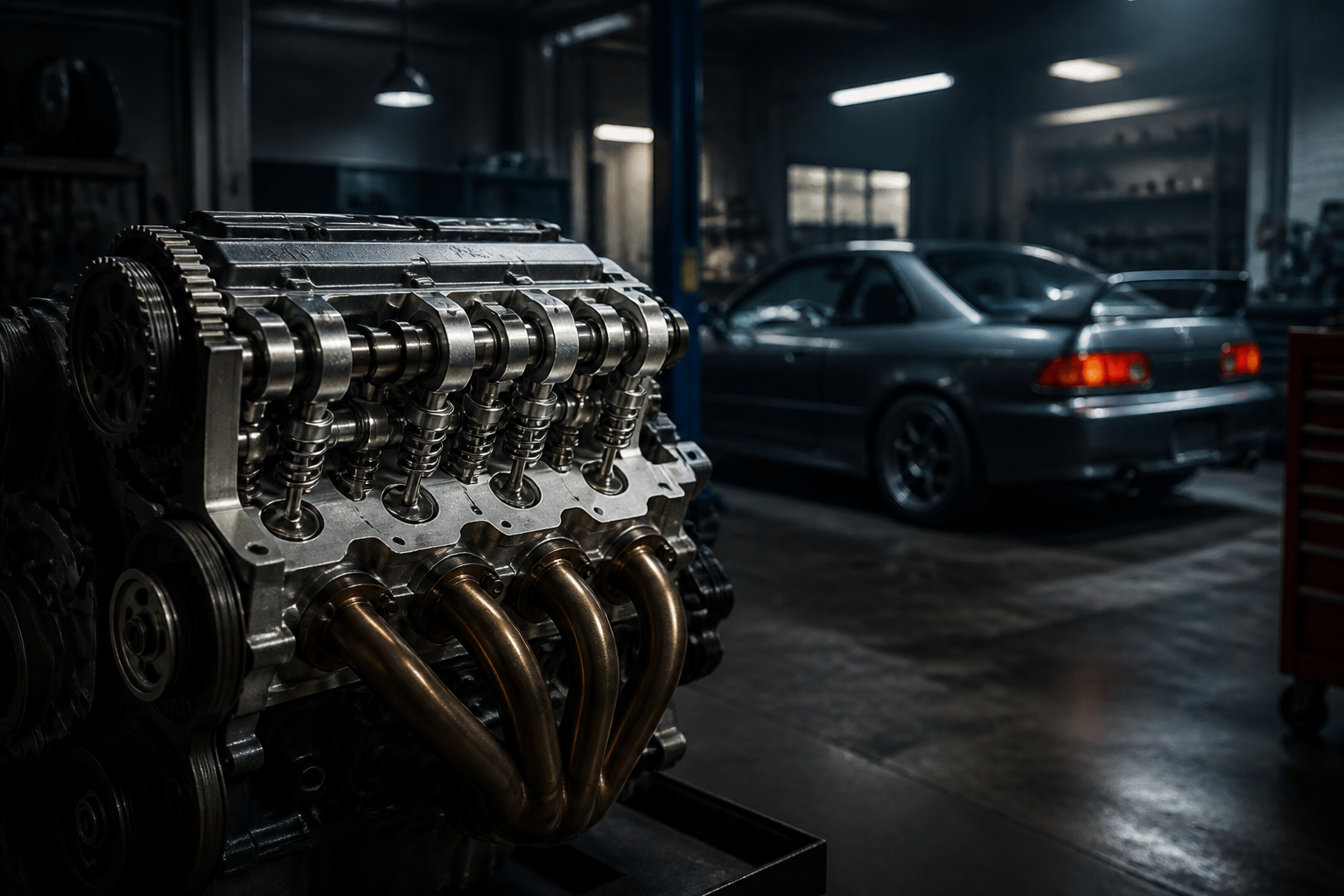
VTEC Explained: How Honda's Variable Valve Timing Actually Works
JDM NINJA · 6/30/2026
VTEC is one of the most famous acronyms in car culture, but how does it actually work? Here's the engineering behind Honda's most celebrated technology, explained simply.
Why VTEC Became More Than a Meme
VTEC is one of the most famous acronyms in car culture, but the idea behind it is practical rather than magical. Honda wanted engines that could be efficient, smooth and usable at low rpm while still breathing like performance engines at high rpm. Variable Valve Timing and Lift Electronic Control was the solution.
That dual personality is why VTEC became so loved. A good Honda performance engine can feel calm around town, then change character dramatically as revs climb. The crossover is not just a noise; it is a mechanical change in how the engine breathes.
The Basic Problem: One Cam Profile Cannot Do Everything
An engine's camshaft controls how far valves open and how long they stay open. A mild cam works well at low rpm because it keeps air speed high and idle quality stable. An aggressive cam helps at high rpm because the engine needs more airflow, but it can make low-speed running rough and inefficient.
Traditional engines had to compromise. Honda's VTEC system lets the engine use one cam profile for normal driving and a more aggressive profile when rpm and load justify it.
How VTEC Switches Profiles
In simplified terms, Honda uses multiple cam lobes and rocker arms. At lower rpm, the engine follows the mild cam lobes. When the ECU sees the right conditions — usually rpm, oil pressure, throttle position and temperature — oil pressure locks the rocker arms together so the valves follow the more aggressive high-rpm lobe.
This is why oil quality and level matter. VTEC relies on oil pressure. A neglected engine with low oil, dirty oil or internal wear may not engage properly. If VTEC engagement feels inconsistent, the issue is often maintenance-related rather than the system itself.
DOHC VTEC vs Economy VTEC
Not every VTEC engine is a Type R engine. Honda used the name across many applications, including economy-focused systems designed for fuel efficiency. Performance DOHC VTEC engines such as the B16B, B18C, F20C and C30A are the ones enthusiasts usually mean when they talk about the classic high-rpm feel.
That distinction matters when buying. A badge or valve-cover text does not automatically mean you are getting the most desirable version. Engine code, head design, gearbox and chassis context all matter.
Why It Feels Special
Classic VTEC engines make modest torque compared with turbo rivals, so they reward revs and gear selection. The driver has to keep the engine in the right part of the powerband. That creates involvement. In cars like the EK9 Civic Type R or S2000, the gearbox, limited-slip differential and chassis are tuned around that behaviour.
The downside is that they can feel flat if you expect turbo torque. A VTEC Honda is not lazy-fast. It is precise, mechanical and best enjoyed by drivers who like using the full rev range.
Buying Checks for VTEC Hondas
- Check oil level, oil-change history and evidence of overheating.
- Listen for valvetrain noise and ask when valve clearances were last set.
- Verify the engine code rather than relying on badges.
- Inspect gearbox synchros, especially on hard-driven Type R models.
- Budget for genuine service parts; cheap ignition and sensor parts can cause poor running.
VTEC became famous because it gave small engines a big personality. Under the jokes is clever engineering that still makes Honda's best naturally aspirated cars feel special.
About the author
JDM NINJA
JDM NINJA is written and edited by Lucas Tougaard, a Denmark-based importer and owner of Japanese-market performance cars since 2019. Every guide is researched in-house from auction results, factory documentation and hands-on ownership — read how we source and verify our data in our editorial standards, or send a correction.
Published 6/30/2026 · Updated 9/7/2026