What Does JDM Mean? A Complete Beginner's Guide
JDM NINJA · 6/30/2026
JDM stands for Japanese Domestic Market — but what makes these cars so special, why are they different from export versions, and why do enthusiasts around the world obsess over them?
JDM Explained From the Beginning
JDM stands for Japanese Domestic Market. It describes cars, engines, and parts that were built and sold specifically for consumers in Japan — not the versions exported to the United States, Europe, or Australia. When someone calls a car a "true JDM," they mean it came directly from the Japanese home market, exactly as Japanese buyers originally received it.
This distinction matters enormously, because Japanese manufacturers routinely gave their home market better cars. More powerful engines, superior suspension setups, rarer trim levels, and exclusive features that never made it to export catalogues. Japan was the performance flagship showroom, and the rest of the world got the diluted version.
Why Are JDM Cars Different From Export Models?
Japanese manufacturers built differently for their home market for several reasons. Japan's strict domestic regulations pushed engineers to develop cleverly, and buyers in Japan had high expectations for performance and quality. The result was cars tuned to a higher standard.
One of the most famous examples is the so-called "gentleman's agreement" of the 1990s — an unofficial arrangement between Japan's major automakers to cap advertised power at 280 horsepower. This kept cars on paper within a range considered acceptable, but the real-world power figures were often considerably higher. Engineers were still building serious performance machines; they just weren't advertising the full number.
Japan also had different emissions and safety certification requirements, which sometimes gave engineers more freedom. Engines designed purely for Japanese roads could be optimised for high-rev output, mechanical character, and driving feel in ways that might have been costly or difficult to certify in other markets.
What Makes JDM Cars Worth Seeking Out?
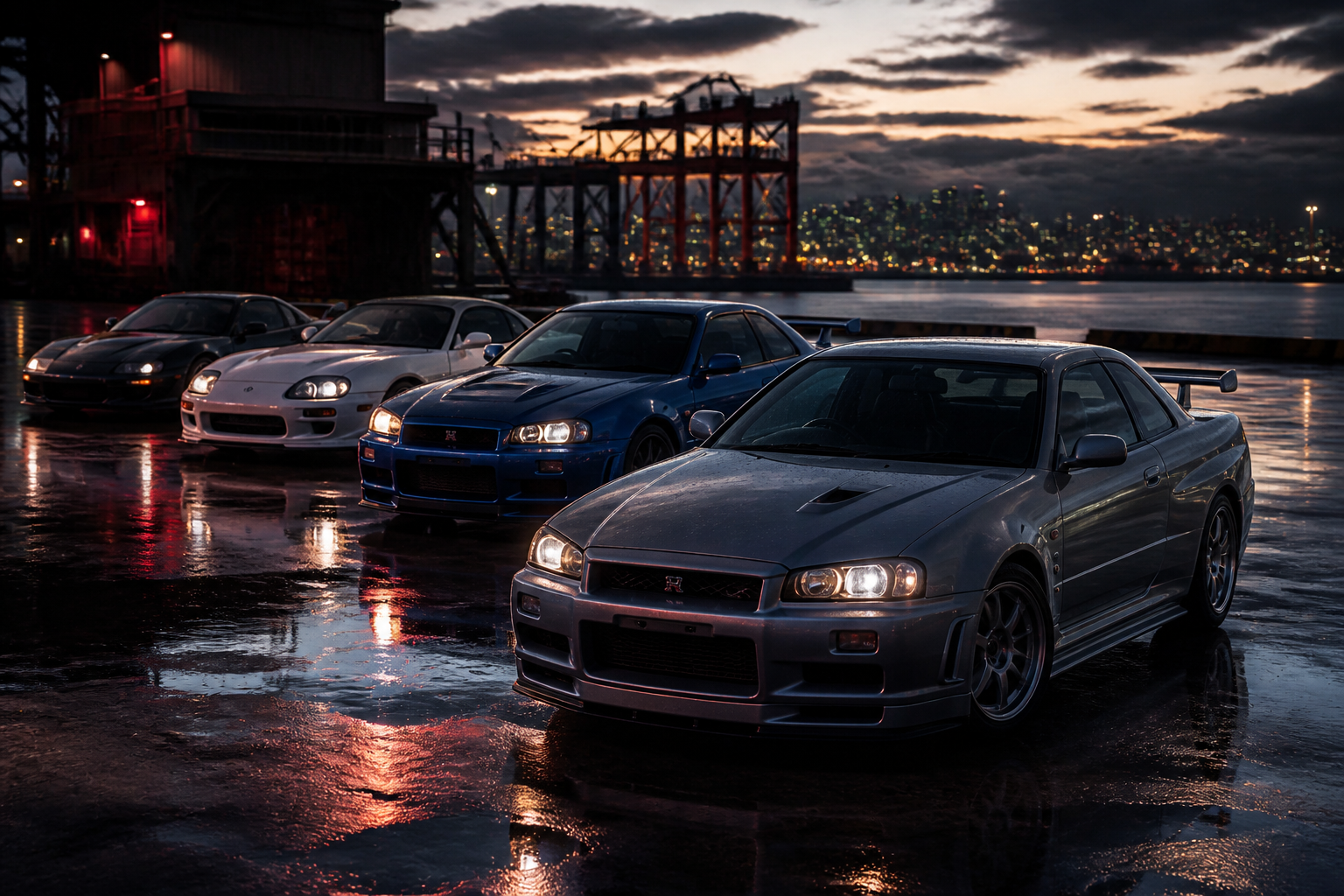
The short answer is that JDM versions usually represent the best the manufacturer ever made. Take the Nissan Skyline GT-R. Japan received the R32, R33, and R34 generations with full twin-turbocharged, four-wheel-drive specification as standard. North America officially received none of them. Europe received limited exports of some variants, but nothing matched the complete JDM package.
The Toyota Supra, the Mazda RX-7, the Honda NSX, the Mitsubishi Lancer Evolution — in every case, the JDM version was the one built without compromise. These cars were designed to be driven hard on Japanese mountain roads, on racetracks, and on the expressways linking Japan's cities. That intent shows in everything from the seat bolstering to the gear ratios.
The Birth of JDM Culture
JDM culture as a global movement began with enthusiasts who wanted access to cars their own countries never officially received. Specialist importers in the United Kingdom, Australia, and New Zealand began bringing in Japanese-market vehicles through grey channels — cars shipped by private sellers or Japanese auction houses rather than through manufacturer distribution networks. The quality and specification of these cars created immediate demand.
As classic JDM sports cars aged past the 25-year threshold required for importation into the United States as historic vehicles, another enormous wave of interest followed. Today, American buyers regularly pay six figures for well-preserved R34 GT-Rs, AE86 Corollas, and FD3S RX-7s — cars that were never officially sold there.
JDM vs Grey Import: What's the Difference?
These two terms are often used interchangeably but they mean different things. A JDM car is one that was originally sold new in Japan for the Japanese domestic market. A grey import is a car brought into another country outside the manufacturer's official distribution channels. Most JDM imports are grey imports by definition, since no manufacturer ships JDM-spec cars through their official dealer network abroad.
Understanding this distinction helps when buying. A car described as a JDM import could be anything from an original-spec GT-R to a standard family car with JDM badging. Always check the full specification against the original Japanese market listing.
Why JDM Culture Keeps Growing
At its core, JDM culture is about a particular philosophy of driving. These cars were built in an era when the goal was driver engagement — light weight, precise steering, engines that rewarded revving, and handling that communicated every corner. That philosophy is increasingly rare in modern performance cars, which makes the originals more valuable every year.
Whether you're drawn to a Silvia S15 for its legendary chassis balance, a Honda Integra Type R for its screaming VTEC engine, or a Subaru Impreza WRX STI for its all-weather performance, you're choosing cars made by engineers who genuinely cared about the driving experience. That passion is exactly what keeps the JDM world alive.
About the author
JDM NINJA
JDM NINJA is written and edited by Lucas Tougaard, a Denmark-based importer and owner of Japanese-market performance cars since 2019. Every guide is researched in-house from auction results, factory documentation and hands-on ownership — read how we source and verify our data in our editorial standards, or send a correction.
Published 6/30/2026 · Updated 9/7/2026