
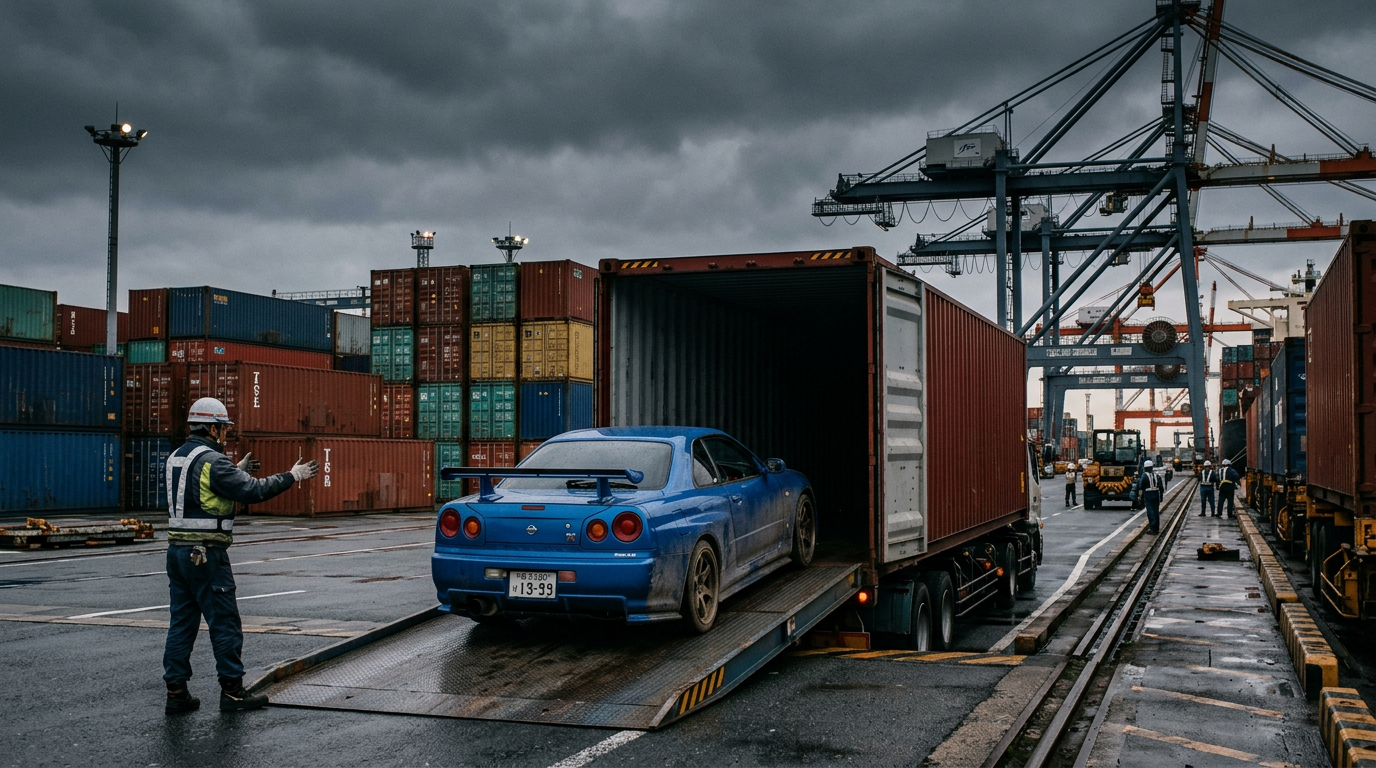
Beyond the Bid: The Hidden Costs of Importing a JDM Car
JDM NINJA · 7/15/2026
You won the auction for your dream car—now what? From inland transport to DOT bond releases, here is a breakdown of the hidden fees that most basic calculators miss.
The auction hammer price is the number everyone quotes and the number almost nobody actually pays. A Nissan Skyline listed at ¥1,800,000 on a Friday morning in Nagoya can quite easily land in your driveway at nearly double that once every fee, tax and unavoidable piece of paperwork has been settled. This guide walks the full cost chain from bid to number plate, with the real ranges we see in 2026, so you can budget properly instead of discovering the gap when the invoice arrives.
1. The bid is only the first line of the invoice
Japanese auction houses (USS, TAA, JU, HAA Kobe) charge the buyer a success fee on top of the hammer price, typically ¥20,000–¥60,000 depending on the house and the price band. Your exporter or bidding agent then adds their own commission: normally ¥80,000–¥150,000 flat, or 5–10% on higher-value cars. Recycling and deregistration fees add another ¥15,000–¥30,000. Before the car has moved a metre, you are typically 8–15% above the hammer price.
Then comes inland transport to the port. Nagoya and Yokohama are cheap if the car is already nearby; a car bought at an inland auction in Sendai or Fukuoka can add ¥30,000–¥80,000 in truck costs alone. Ask your agent which port they use before bidding, not after.
2. Shipping: RoRo versus container
Roll-on/roll-off is the default and the cheapest. Container shipping costs more but protects the car and lets you ship parts and wheels inside it.
| Method | Typical cost to Northern Europe | Transit | Notes |
|---|---|---|---|
| RoRo (shared deck) | €1,300–€2,000 | 6–9 weeks | Nothing may be left inside the car |
| Shared 40ft container (2 cars) | €1,800–€2,600 per car | 7–10 weeks | Parts can travel with the car |
| Sole-use 20ft container | €3,200–€4,500 | 7–10 weeks | Best for low, modified or rare cars |
Marine insurance is separate and usually 1.5–2.5% of declared value. It is not optional in any sane budget: a car damaged on a deck without cover is your loss entirely.
3. Import duty and VAT are where the budget really moves
For most of Europe, a passenger car from Japan attracts 10% customs duty on the CIF value (car + insurance + freight), and then VAT is calculated on the duty-inclusive total. That compounding is what catches people out — VAT is charged on the duty, not just the car.
A worked example on a €15,000 CIF car in Denmark:
- CIF value: €15,000
- Customs duty at 10%: €1,500
- Taxable base: €16,500
- VAT at 25%: €4,125
- Landed cost before registration tax: €20,625
Cars over 30 years old often qualify for reduced treatment — in several EU states a genuine historic vehicle can drop to 0% duty and a reduced VAT rate, but only with correct classification and documentation. This is the single largest legal saving available to importers, and it is why a 1995 car can be dramatically cheaper to land than a 1997 one.
4. Registration tax: the country lottery
This is the step that decides whether importing makes sense at all. Denmark's registration tax can exceed the entire value of the car. Germany, the Netherlands and Sweden are far gentler. Our import calculator models 13 countries with current rates, and it is worth running before you fall in love with a listing.
Beyond the tax itself, budget for the technical side of registration: roadworthiness inspection (€80–€250), headlight conversion for right-hand-drive beam pattern (€150–€600), rear fog lamp fitment where required, speedometer conversion or a compliant secondary display, and often a CoC-substitute engineering report for cars with no European type approval (€300–€900). A modified car — aftermarket suspension, non-standard exhaust, aero — can need individual approval, which is where costs become genuinely unpredictable.
5. The costs nobody puts in the spreadsheet
- Port storage and demurrage. Free time is usually 3–5 days. Miss it while paperwork clears and you pay €20–€60 per day.
- Customs brokerage. €150–€400 for the declaration itself.
- Transport from port to home. The car is unregistered and often uninsured; a transporter is €200–€600.
- Immediate maintenance. Assume timing belt, all fluids, brake hoses and tyres. Japanese cars are usually well maintained but often low-mileage and time-aged: rubber perishes on the calendar, not the odometer. Budget €800–€2,500.
- Rust remediation. Japanese salt use is lower than Scandinavia's, but coastal cars and Hokkaido cars do rot. Auction grade sheets flag corrosion with the letters W, A and S on the diagram — learn to read them, or read our guide to the auction grading system.
- Currency movement. Between bid and final payment you are exposed to JPY moves. A 4% swing on a ¥2,000,000 car is real money.
6. A realistic all-in example
| Line | Cost |
|---|---|
| Hammer price (¥1,800,000) | €10,900 |
| Auction + agent + dereg fees | €1,300 |
| Inland transport + port handling | €450 |
| Shipping + marine insurance | €1,900 |
| Customs duty (10%) | €1,455 |
| VAT (25% on duty-inclusive) | €4,001 |
| Brokerage, inspection, compliance work | €900 |
| Post-arrival service and tyres | €1,400 |
| Total, excluding registration tax | €22,305 |
That is roughly double the hammer price — and registration tax in a high-tax country can add more again. Cars like the Skyline R34 GT-T and Chaser JZX100 still make sense at those numbers because European supply is thin, but the maths only works if you go in with the full figure.
7. How to protect yourself
- Get a written, itemised quote from your agent covering every fee up to port of arrival.
- Model registration tax for your specific country and model year before bidding, not after.
- Set a hard maximum bid equal to your target landed cost minus every downstream fee, and do not move it in the room.
- Insist on the original auction sheet and a translation. Grade 4 with a clean diagram is the sensible floor for a car you plan to keep.
- Keep 15% of the landed cost in reserve for arrival work. You will use it.
Importing is still one of the best ways to get a genuine, unmolested Japanese car — but the winning bid is the beginning of the invoice, not the end of it. Run the numbers, then run them again with the reserve included.
About the author
JDM NINJA
JDM NINJA is written and edited by Lucas Tougaard, a Denmark-based importer and owner of Japanese-market performance cars since 2019. Every guide is researched in-house from auction results, factory documentation and hands-on ownership — read how we source and verify our data in our editorial standards, or send a correction.
Published 7/15/2026 · Updated 9/7/2026